
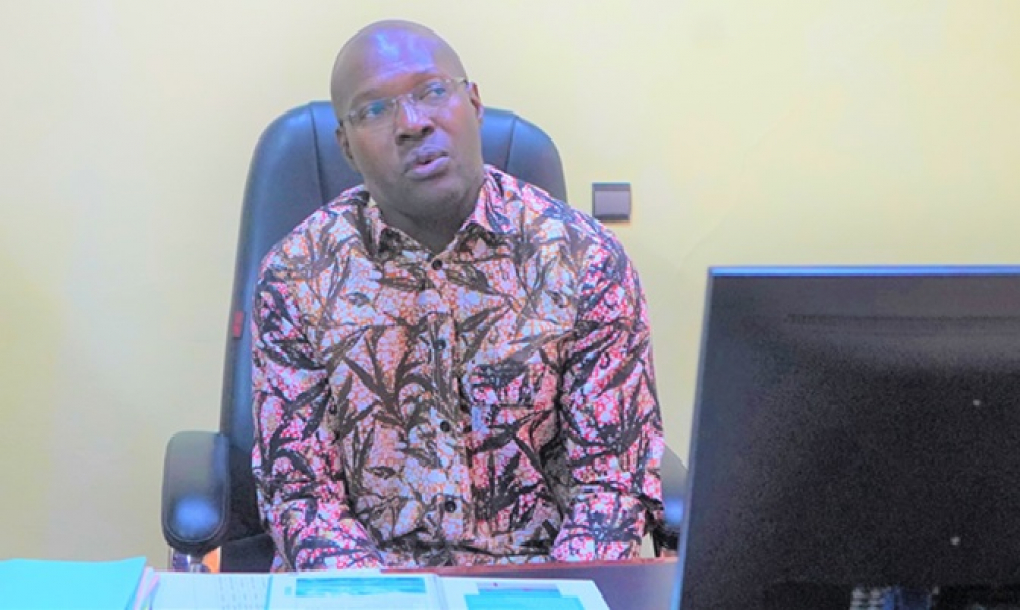
Interview: “(…) but ultimately, who do we want to lead Burkina Faso?”, Dr. Zacharia TIEMTORE (former minister, president of ISSH)
Burkina Faso has been in the eye of the terrorist storm for nearly seven years now, leading to instability at the highest levels of government with three heads of state in a single year (2022) following two military coups, each believing they were providing « the right answer » to the fight against the evil that is ravaging the country. But alas, we are still in this situation as of February 8, 2023, when we meet with Dr. Zacharia TIEMTORE for a comparative analysis of the national situation.
With a doctorate in Education Sciences and degrees in Political Science and Sociology, the former Minister of Literacy of Burkina Faso (2011-2013) and Member of Parliament (2013-2014) has a rather atypical approach to the possible response in such a situation. For several years, he has been involved in research, strategic analysis, and training related to the issue of « human security. » Co-founder and President of the Higher Institute of Human Security (ISSH), here is a summary of our discussion with him.
INFOBF.NET: You were a government minister and then a member of parliament. But since 2015, you have completely disappeared from the political scene. What’s going on? Are you no longer interested in politics?
Dr. Zacharia TIEMTORE: [Laughs] Thank you for your interest and for this opportunity to talk during this period of uncertainty and complexity, during these difficult times our country is going through. To be precise, I try to be discreet and take time to reflect. I have chosen to speak only when I think my words can shed light on the situation or open up new possibilities. So, since 2014-2015, I have made a few media appearances and notably signed an opinion piece on the eve of the 2020 elections, where I called for reflection, unity, and bold solutions to counter the deteriorating national situation. Because simply holding elections and appointing a president would not solve the problems that were at hand. Yes, I have withdrawn from partisan politics. I became involved in politics at a very young age, and for over ten years, I learned a great deal and gave of myself. But at a certain point in your life, you contribute what you can, and then you have to return to reality, to the everyday life of any ordinary citizen. For me, after those wonderful years of learning and self-sacrifice, it was good to take a step back and be useful in a different way, and that’s what I’ve been doing since 2015.
But can we expect you to return to the political scene in Burkina Faso one day?
It’s true that I’m no longer involved in partisan politics, but there are still causes close to my heart that I fight for. I continue to make my modest contribution through reflection and action; it’s just that I no longer belong to a political party with the associated obligations. So I withdrew, but what will tomorrow bring? I don’t know! Will I find myself tomorrow with other citizens to wage a political battle? I don’t know! It all depends on how things develop, but each of us wants the best for this country, and each of us must do our part to make that best happen.
Since then, you have returned to higher education and you train students, among other things, in the field of « human security, » as your institute, ISSH, is named. What exactly is « human security »?
This notion of « human security » seems fundamental to me today. It represents an understanding, and above all a way of producing security, that differs from the traditional approach to security, which emphasized the security of states. Indeed, a few decades ago, threats were considered external, and what was needed was to have forces capable of defending territories, capable of protecting borders from external aggression. The struggles for peace and the evolution of the world have led to a questioning of this traditional conception of security. Moreover, the main threats have changed in nature. Alongside the relatively minor risk of one state directly attacking another, there is the higher risk of internal conflict between communities within the same territory, linked to weak human security. It is therefore no longer primarily a matter of defending the state against external aggression, but rather of combating human insecurities to respond to an increasingly strong internal threat. Indeed, if the borders of a territory are protected and within that territory individuals do not live with dignity, free from want and fear, then we can say that there is still no security in that territory and that peace itself is in danger.So, for about three decades now, there has been an international desire to rethink security, focusing on the security of individuals rather than simply and primarily on the security of states. But since states are made up of individuals and institutions, if we succeed in building strong human security, individuals themselves become providers of security and agents of peace. Such a conception of security requires a shift in perspective and approach, allowing us to consider security as a given, a fact emanating from individuals and territories. Concretely, an individual needs to feel safe (physically, in terms of health, education, food, the environment, etc.), and we are clearly seeing this in certain areas of Burkina Faso, where men and women, due to a lack of human security, have taken up arms against the state. This means that security must be built around the human element. So the phenomenon of security or insecurity is linked to thought patterns that are totally unique to humans, and that is ultimately what we need to try to understand, and that is where we need to be present.
Does this mean, then, that Burkina Faso, with the crisis we are experiencing, failed to recognize and anticipate the issue of « human security »?
Absolutely! I believe we failed to anticipate these factors, nor did we distinguish between « positive peace » and « negative peace. » The former allows us to build together and achieve lasting common goals in harmonious relationships, prioritizing the peaceful resolution of conflicts. The latter is an unstable peace, a superficial peace devoid of the lifeblood of inclusion and harmonious coexistence. Sometimes, a state settles for a negative peace, failing to invest in building lasting peace. In Burkina Faso, we are so preoccupied with the present and finding immediate solutions to current concerns that we don’t always have enough time or capacity to step back and reflect on certain events, to conduct strategic analysis. Therefore, being trapped by the immediate is something that always seems detrimental in the long run. We must skillfully combine the two. To this end, our countries should first reconnect with themselves, identify our values, and see in our intangible and tangible resources what we have at our disposal to envision and organize our future. Yes, it can be said that this human dimension of security has not been sufficiently explored and established as a path to follow, despite the appeals of many of us.In our countries, we don’t seek out the root causes of our problems in order to address them; we readily mistake the consequences for the causes, and that’s why we often achieve mixed results.
[…] we have long considered ourselves a Nation, whereas a Nation is a construct; a Nation cannot be decreed!
It could be said that your teaching modules address the areas where Burkina Faso is most troubled (peace, security, education, etc.). Given this experience, what are the possible solutions to the crisis?
Let’s cultivate humility first! You know, when faced with a problem, everyone thinks they have the solution. Sometimes, we even commit what could be called a sin of pride, thinking that the solution will only come from ourselves. From the outset, how can every Burkinabè demonstrate humility by first recognizing the complexity of the situation we are in and acknowledging that it’s not something that can be solved just like that, with the snap of a finger? We continue, for example, to think that there are good Burkinabè and bad Burkinabè, but we must realize that it’s not a few individuals who can find the solution, but the entire national community in constant dialogue with itself. Beyond rhetoric, we must trigger a dynamic that shows this matter concerns everyone. We must also come to understand precisely the nature of the conflict on our territory and discuss the reality of the national social fabric, riddled with deep divisions. For a long time, we considered ourselves a nation, but a nation is a construct; it cannot be decreed. A nation must be built, just like a state. Today, we must ask ourselves the question:What have we done on these two major issues? What kind of State and what kind of Nation have we built? What are the strengths and weaknesses of our State and our Nation? What can we do to consolidate our strengths and address our weaknesses? This question must concern us and inform our conflict resolution strategy because you do not wage war on a brother the same way you wage war on an enemy from elsewhere whom you do not know. Because if you want the community to continue to thrive, you are obliged to take into account the fraternal dimension of those you are fighting. This leads us to ask ourselves what we have not been able to do or have not known how to do as a national community. We must then look at ourselves honestly, examine our successes and failures, seek the causes within ourselves and among us, and it is in this way that we will now be able to build solutions.
In light of everything you’ve said, what is your assessment of the different responses each regime has attempted to implement in the fight against terrorism? (Roch Kaboré, Paul Henri Damiba, and Ibrahim Traoré regimes).
What I was saying earlier about humility is something I truly believe. Therefore, I believe that since 1960, every leader we have had in Burkina Faso has wanted the best for this country; each has done what they thought was right for Burkina Faso. It would be a mistake to believe that there are leaders who don’t want the best for the country. At least, that’s not how I see things, and it profoundly changes the perspective. I believe that each one did their best, with results that can obviously be judged differently. Know that no matter who the best son or daughter you put at the head of the country is, as long as we remain stuck in this logic of good guys and bad guys, we will continue to see them come and go, one after another, with results that will never live up to expectations. I think everyone has tried in their own way to lead the country toward a better future, and no one is perfect, but we must recognize that we Burkinabè can sometimes be very contradictory, and this leads me to ask this question: ultimately, who do we want to lead Burkina Faso? It seems that no one, no leader, will find favor in the eyes of the Burkinabè people, and that, at some point, is worrying! Where do we think we’re going to find this extraordinary person with miracle solutions for the country? No, we have to stop with this messianic mindset! Perhaps we need to be a little more humble, more collectively intelligent, more attentive, and more collaborative in our management… that’s why I was saying that, for me, the most important thing is to cultivate a deep humility.
So, in these circumstances, how do you envision the future of Burkina Faso in 15 or 20 years?
Today, it’s about building hope on reality, about affirming that this complex crisis can and must be an opportunity for us to strengthen ourselves as a people. I’ve highlighted two issues that seem crucial to me: the question of state-building and the building of a balanced nation. My team and I are reflecting deeply on these topics because we believe there’s truly something to explore, to discover, to create. So, if I look ahead, I would say that Burkina Faso in 20 years will be a country that has had a very difficult past, a country that has seized this opportunity to build a true nation where every citizen feels a sense of belonging, regardless of their ethnic, religious, or economic background. In 20 years, we will have built a state that reflects who we are, where public services are not just a mirage but a reality across the entire territory, and where, through education, we will have succeeded in reconnecting with ourselves, reconnecting with our values, and where we will have created individuals who feel sufficiently secure. That’s why we’ve been working on this concept of human security for the past ten years, because we anticipated it. Back then, when we started out, some people asked us, « What’s this ‘human security’ business all about? » And our answer was: « In 15 years, you won’t even be asking this question anymore, it will seem so obvious and everyone will know the answers. » Even then, we sensed that this race toward soulless development was producing despair, producing misery, and that this misery would eventually erupt, and in a very violent way. Finally, I believe that in 20 years, our institutional framework will also include specialists in strategic thinking and positive foresight, whom we will know how to listen to and question. In this way, we will no longer wait for a problem to arise before trying, mired in the quagmire, to find a quick and ineffective solution. We will distinguish ourselves by our ability to anticipate, our capacity not to deny disagreements but to address them courageously in order to build solid compromises protected by all. We will then know how to build intelligent and robust balances as a response to the complexity of our world.
Interview conducted by Modeste KONOMBO
Infobf.net